
Best fit
Who should use this template
Designed for entry-level applications, with a strong fit for these fields and career stages.
GeneralSalesCustomer serviceAdministrationEntry levelProfessional
Resume/CV template guide
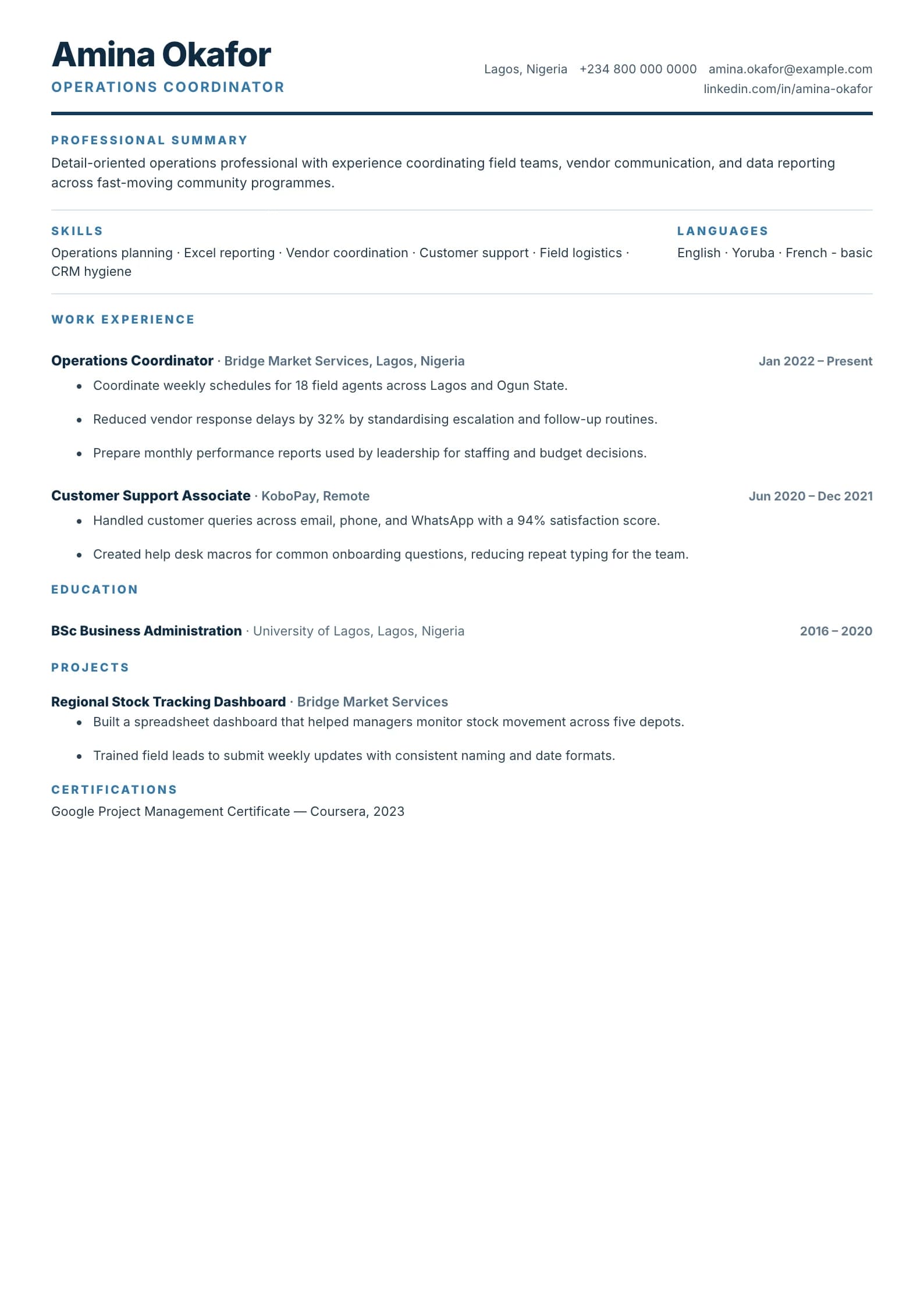
A focused one-page resume with compact achievements, clear hierarchy, and ATS-safe structure.
One-page ATS is designed for candidates who can present their most relevant qualifications without a second page. Its single-column reading order, compact evidence blocks, and standard headings support fast recruiter review and parsing-led application systems.
Format strengths
Use this structure when its hierarchy supports the evidence you need a recruiter to notice first.
Best fit
Designed for entry-level applications, with a strong fit for these fields and career stages.
Use it carefully
Detailed template analysis
One-page ATS is intended for candidates whose relevant story can be communicated in a single focused page. Start with the target vacancy and rank every section by hiring value. The name, target role, contact details, short profile, selected skills, recent experience, and education should form one predictable reading sequence. Graduates can replace a thin employment history with internships, placements, projects, volunteering, or coursework that demonstrates the required capability.
Keep the profile to a few precise lines and avoid generic personal qualities. Each role should contain only the strongest outcomes or responsibilities that distinguish the candidate. Two to four concise bullets are normally more useful than a long task inventory. Skills should echo relevant job language truthfully, while education should include the qualification and institution without consuming space needed for evidence.
A one-page label is a content strategy, not permission to hide information or shrink text until it is uncomfortable. Review the exported document at normal zoom and make sure dates, employers, qualifications, and bullet indentation remain easy to distinguish. Remove duplicated duties, old unrelated roles, weak adjectives, full street addresses, and references before changing typography. Links should be short, useful, and tested.
If the candidate has several relevant positions, regulated credentials, major projects, or ten years of experience, a second page may be the more professional choice. This template will preserve overflow rather than crop it. The first page should still carry the strongest evidence, and any second page should contain meaningful content rather than one orphaned heading or a single bullet.
Content priorities
The visual format earns attention only when the most relevant evidence appears in the right sections.
State the role, relevant level, strongest capability, and the setting in which you can contribute.
Choose recent roles, internships, or projects and keep two to four outcome-led bullets for each.
Prioritize vacancy keywords you genuinely possess and keep qualifications concise and verifiable.
How to use it
Keep the structure useful, replace every example, then test the final file as a recruiter would see it.
Keep the sections that support your target role and remove irrelevant placeholders.
Replace sample text with accurate tools, scope, achievements, education, and links.
Check hierarchy, dates, spelling, and page length before exporting PDF or DOCX.
Template FAQ
It is usually suitable for students, graduates, entry-level applicants, focused career changers, and candidates with a short relevant work history.
The template preserves all content and safely adds another page. Edit repetition and unrelated detail before reducing readable text size.
Use the layout as a starting point, then make every section specific to your next application.
Open the editor